
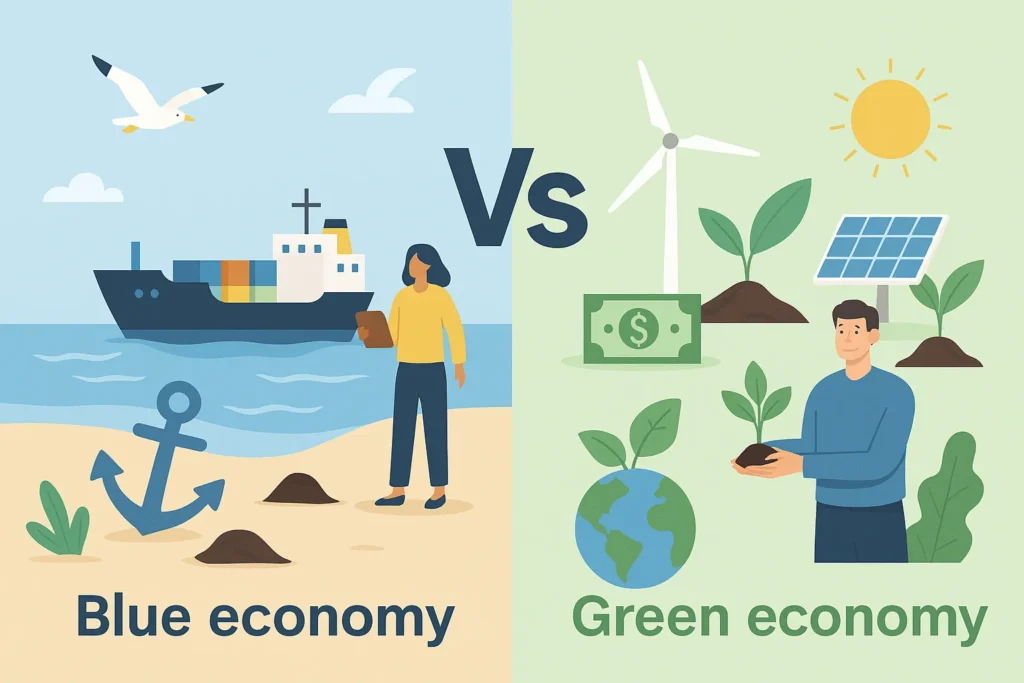
Ever wondered if “going green” is the only way to save our planet? What if I told you there’s another shade of environmentalism gaining traction, one that focuses on the vast potential of our oceans? We’re diving deep into the world of sustainable economics, comparing the blue economy vs green economy. Get ready to explore how both approaches aim to protect our planet while fostering economic growth. You’ll learn their key differences, similarities, and how they can work together for a brighter future.
Understanding the Green Economy
The green economy has been a buzzword for quite some time. It’s all about making economic activities environmentally sustainable.
It aims to reduce environmental risks and ecological scarcities. This is achieved through investments that reduce pollution and greenhouse gas emissions.
Core Principles of the Green Economy
The green economy rests on several key principles. These guide its actions and strategies.

- Resource Efficiency: Using resources more efficiently to minimize waste and environmental impact.
- Renewable Energy: Transitioning to renewable energy sources like solar, wind, and hydro power.
- Sustainable Agriculture: Promoting farming practices that protect soil health and biodiversity.
- Ecosystem Protection: Conserving and restoring natural ecosystems to maintain their vital functions.
Examples of Green Economy Initiatives
You see the green economy in action all around. Here are a few examples.
- Solar Panel Installations: Governments and businesses are investing heavily in solar energy.
- Electric Vehicle Production: Automakers are shifting towards electric vehicles to reduce emissions.
- Organic Farming: Farmers are adopting organic practices to produce food without harmful chemicals.
- Green Building Construction: Buildings are being designed and constructed to be more energy-efficient and environmentally friendly.
Exploring the Blue Economy
Now, let’s turn our attention to the blue economy. This concept focuses specifically on the sustainable use of ocean resources.
It encompasses a wide range of activities, from fishing and tourism to renewable energy and marine biotechnology. The goal is to balance economic growth with the health of our oceans.
Key Sectors of the Blue Economy
The blue economy includes various sectors that rely on the ocean.
- Sustainable Fisheries: Managing fish stocks responsibly to ensure long-term availability.
- Coastal Tourism: Developing tourism that minimizes environmental impact and supports local communities.
- Offshore Renewable Energy: Harnessing wind, wave, and tidal energy from the ocean.
- Marine Biotechnology: Developing new products and technologies from marine organisms.
- Maritime Transport: Making shipping more efficient and environmentally friendly.
- Aquaculture: Farming aquatic organisms in a sustainable way.
The Importance of Ocean Health
The blue economy recognizes that a healthy ocean is essential for its success.
Pollution, overfishing, and climate change threaten ocean ecosystems. These threats also impact the economic activities that depend on them.
Sustainable practices are crucial to ensure the long-term viability of the blue economy.
Blue Economy vs Green Economy Compared: Key Differences
While both aim for sustainability, there are crucial distinctions between the blue economy vs green economy.
The green economy is broader, encompassing all sectors. The blue economy focuses specifically on ocean-related activities.
Scope and Focus
- Green Economy: Covers all aspects of economic activity, aiming to make them environmentally sustainable.
- Blue Economy: Concentrates on the sustainable use of ocean and coastal resources.
Resource Base
- Green Economy: Addresses a wide range of resources, including land, air, and water.
- Blue Economy: Primarily focuses on marine resources and ecosystems.
Sectoral Coverage
- Green Economy: Includes sectors like agriculture, energy, transportation, and manufacturing.
- Blue Economy: Includes sectors like fisheries, tourism, shipping, and offshore energy.
Blue Economy vs Green Economy Compared: Similarities
Despite their differences, the blue economy vs green economy also share common ground.
Both prioritize environmental sustainability and resource management.
Shared Goals
- Environmental Protection: Both aim to minimize environmental impact and protect natural resources.
- Sustainable Development: Both promote economic growth that is environmentally and socially responsible.
- Resource Efficiency: Both emphasize the efficient use of resources to reduce waste and pollution.
- Innovation and Technology: Both encourage the development and adoption of innovative technologies to promote sustainability.
Interconnectedness
The blue and green economies are not mutually exclusive. They are interconnected and can support each other.
For example, renewable energy (green economy) can power offshore platforms (blue economy). Sustainable agriculture (green economy) can reduce runoff that pollutes coastal waters (blue economy).
The Benefits of a Thriving Blue Economy
A well-managed blue economy can bring significant benefits.
These benefits extend to the environment, economy, and society.
Economic Growth
The blue economy can create new jobs and industries.
Sustainable fisheries, tourism, and renewable energy projects can boost economic growth.
Environmental Protection
Sustainable practices can protect ocean ecosystems.
Reducing pollution, managing fish stocks, and conserving habitats are crucial.
Social Benefits
The blue economy can improve the livelihoods of coastal communities.
Sustainable tourism and fisheries can provide income and employment opportunities.
Food Security
Sustainable fisheries and aquaculture can contribute to food security.
Responsible management of marine resources ensures a stable supply of seafood.
The Challenges Facing the Blue Economy
Despite its potential, the blue economy faces several challenges.
Addressing these challenges is crucial for its success.
Overfishing
Overfishing depletes fish stocks and damages marine ecosystems.
Sustainable fisheries management is essential to address this issue.
Pollution
Pollution from land-based sources and shipping threatens ocean health.
Reducing pollution through better waste management and cleaner technologies is crucial.
Climate Change
Climate change impacts ocean temperatures, sea levels, and ocean acidification.
Mitigating climate change and adapting to its impacts are essential for the blue economy.
Lack of Investment
Insufficient investment in sustainable blue economy projects hinders their development.
Attracting investment from both public and private sources is crucial.
Strategies for Promoting a Sustainable Blue Economy
To ensure the long-term success of the blue economy, several strategies can be implemented.
These strategies involve governments, businesses, and communities.
Policy and Regulation
Governments can establish policies and regulations that promote sustainable practices.
These can include fishing quotas, pollution controls, and marine protected areas.
Investment in Research and Innovation
Investing in research and innovation can lead to new technologies and solutions.
These can improve the efficiency and sustainability of blue economy activities.
Capacity Building
Providing training and education can build the capacity of individuals and organizations.
This can improve their ability to manage and utilize marine resources sustainably.
Community Engagement
Engaging local communities in decision-making processes can ensure that their needs and concerns are addressed.
This can also promote a sense of ownership and responsibility for marine resources.
International Cooperation
Collaborating with other countries can address shared challenges and promote sustainable practices.
This can include sharing best practices, coordinating research, and establishing international agreements.
Case Studies: Successful Blue Economy Initiatives
Several countries and regions have successfully implemented blue economy initiatives.
These examples provide valuable lessons and insights.
Norway: Sustainable Fisheries Management
Norway has implemented strict regulations to manage its fisheries sustainably.
This has helped to maintain healthy fish stocks and support the fishing industry.
Seychelles: Marine Protected Areas
The Seychelles has established marine protected areas to conserve biodiversity and promote sustainable tourism.
This has helped to protect coral reefs, seabirds, and other marine species.
Iceland: Geothermal Energy
Iceland utilizes geothermal energy to power its industries and homes.
This reduces its reliance on fossil fuels and lowers its carbon footprint.
Palau: Ecotourism
Palau promotes ecotourism to generate revenue while protecting its natural environment.
This has helped to conserve its coral reefs, rainforests, and other ecosystems.
The Future of the Blue Economy
The blue economy has the potential to play a significant role in the future.
By embracing sustainable practices and investing in innovation, we can unlock its full potential.
Technological Advancements
Technological advancements can transform the blue economy.
These advancements can improve the efficiency and sustainability of various activities.
Increased Investment
Increased investment in sustainable blue economy projects can drive innovation and growth.
This can create new opportunities and benefits for communities and businesses.
Global Collaboration
Global collaboration is essential to address shared challenges and promote sustainable practices.
This can lead to more effective policies and solutions.
A Circular Economy Approach
Adopting a circular economy approach can minimize waste and maximize resource efficiency.
This can help to create a more sustainable and resilient blue economy.
Integrating Blue and Green Economy Principles
The most effective approach involves integrating principles from both the blue economy vs green economy.
This creates a holistic framework for sustainable development.
Combining Strengths
By combining the strengths of both approaches, we can achieve greater environmental and economic benefits.
This requires collaboration and coordination across sectors and stakeholders.
Holistic Planning
Holistic planning is essential to ensure that blue and green economy initiatives are aligned and mutually supportive.
This involves considering the interconnectedness of ecosystems and economic activities.
Long-Term Vision
A long-term vision is needed to guide the development of a sustainable blue-green economy.
This vision should be based on scientific evidence and stakeholder input.
Conclusion
The blue economy vs green economy are not competing concepts, but rather complementary approaches to achieving sustainable development. While the green economy takes a broad view of environmental sustainability across all sectors, the blue economy focuses specifically on the sustainable use of ocean resources. Both prioritize environmental protection, resource efficiency, and innovation. By integrating the principles of both, we can unlock the full potential of our planet’s resources while ensuring a healthy and prosperous future for all. The time to act is now. What are your thoughts on the role of the blue economy in shaping a sustainable future? Share your ideas and experiences!
Frequently Asked Questions (FAQ)
Here are some frequently asked questions about the blue economy and green economy.
What is the main difference between the blue economy and the green economy?
The main difference lies in their scope. The green economy covers all sectors, aiming to make them environmentally sustainable. The blue economy focuses specifically on the sustainable use of ocean and coastal resources.
Why is the blue economy important?
The blue economy is important because it recognizes the vital role of oceans in economic growth, food security, and environmental sustainability. It promotes responsible management of marine resources.
How can I contribute to a sustainable blue economy?
You can contribute by supporting sustainable seafood choices, reducing your plastic consumption, participating in coastal cleanups, and advocating for policies that protect ocean ecosystems.