
Ever wondered how governments and central banks try to steer the economic ship? It’s like they have different sets of controls, right? Understanding these controls can feel like deciphering a secret code.
This article will break down the key differences between fiscal policy vs monetary policy. We’ll explore how each one works, their strengths and weaknesses, and real-world examples of them in action. Get ready to navigate the world of economics with confidence!
Fiscal Policy vs. Monetary Policy: Key Differences Explained
Fiscal and monetary policies are the two primary tools used to influence a nation’s economic activity. While both aim for economic stability and growth, they operate through distinct mechanisms and are implemented by different entities. Let’s dive into the specifics.
What is Fiscal Policy?
Fiscal policy involves the government’s use of spending and taxation to influence the economy. Think of it as the government using its budget to either stimulate or cool down economic activity.
It’s a powerful tool that can directly impact aggregate demand. Governments can use it to address recessions, inflation, and other economic challenges.
How Does Fiscal Policy Work?
Fiscal policy works through two main levers: government spending and taxation.

Government Spending: This includes investments in infrastructure, education, healthcare, defense, and other public services. Increased government spending injects money into the economy, creating jobs and stimulating demand.
Taxation: Tax policies can either encourage or discourage economic activity. Lowering taxes puts more money in the hands of consumers and businesses, potentially boosting spending and investment. Conversely, raising taxes can reduce spending and cool down an overheating economy.
Types of Fiscal Policy
There are two main types of fiscal policy: expansionary and contractionary.
Expansionary Fiscal Policy: This is used during economic downturns or recessions. It involves increasing government spending and/or decreasing taxes to stimulate demand and boost economic growth. The goal is to put more money into the hands of consumers and businesses, encouraging them to spend and invest.
Contractionary Fiscal Policy: This is used during periods of high inflation or rapid economic growth. It involves decreasing government spending and/or increasing taxes to cool down the economy and prevent it from overheating. The goal is to reduce demand and slow down the pace of economic growth.
Advantages of Fiscal Policy
Direct Impact: Fiscal policy can directly impact aggregate demand and target specific sectors of the economy. For example, infrastructure spending can create jobs and improve transportation networks.
Effective During Recessions: Fiscal policy can be particularly effective during recessions when monetary policy may be less effective due to low interest rates.
Addresses Social Needs: Fiscal policy can be used to address social needs, such as poverty reduction and healthcare access.
Disadvantages of Fiscal Policy
Implementation Lags: Fiscal policy can take time to implement due to the legislative process and bureaucratic hurdles.
Political Considerations: Fiscal policy decisions can be influenced by political considerations, rather than purely economic ones.
Crowding Out: Increased government spending can potentially crowd out private investment, reducing the overall impact on the economy.
Examples of Fiscal Policy
The American Recovery and Reinvestment Act of 2009: This was a massive stimulus package enacted in response to the 2008 financial crisis. It included tax cuts, infrastructure spending, and aid to state and local governments.
Tax Cuts and Jobs Act of 2017: This legislation significantly reduced corporate and individual income taxes in the United States.
Government investment in renewable energy projects: This can stimulate economic growth while also promoting environmental sustainability.
What is Monetary Policy?
Monetary policy involves a central bank’s actions to control the money supply and credit conditions to influence economic activity. Think of it as the central bank fine-tuning the economy through interest rates and other tools.
It primarily focuses on managing inflation and maintaining stable prices. Central banks use various tools to achieve these goals.
How Does Monetary Policy Work?
Monetary policy works through several key mechanisms:
Interest Rate Adjustments: Central banks can raise or lower interest rates to influence borrowing costs for businesses and consumers. Lowering interest rates encourages borrowing and spending, while raising interest rates discourages it.
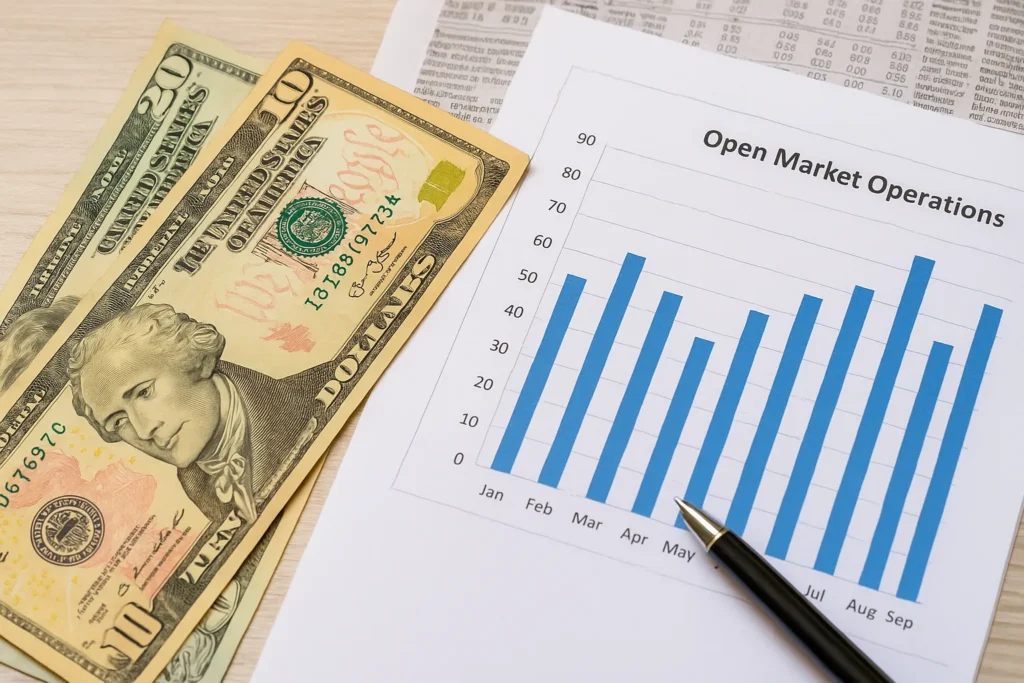
Open Market Operations: This involves the central bank buying or selling government securities to influence the money supply. Buying securities injects money into the economy, while selling securities withdraws money.
Reserve Requirements: Central banks can set reserve requirements, which are the percentage of deposits that banks must hold in reserve. Lowering reserve requirements allows banks to lend out more money, while raising them restricts lending.
Quantitative Easing (QE): This involves a central bank purchasing assets, such as government bonds or mortgage-backed securities, to inject liquidity into the market and lower long-term interest rates. QE is typically used when interest rates are already near zero.
Types of Monetary Policy
Similar to fiscal policy, there are two main types of monetary policy: expansionary and contractionary.
Expansionary Monetary Policy: This is used during economic downturns or recessions. It involves lowering interest rates, buying government securities, and/or lowering reserve requirements to increase the money supply and stimulate economic growth.
Contractionary Monetary Policy: This is used during periods of high inflation or rapid economic growth. It involves raising interest rates, selling government securities, and/or raising reserve requirements to decrease the money supply and cool down the economy.
Advantages of Monetary Policy
Flexibility: Monetary policy can be implemented quickly and adjusted as needed in response to changing economic conditions.
Independence: Central banks are typically independent from political influence, allowing them to make decisions based on economic considerations.
Broad Impact: Monetary policy can have a broad impact on the economy, affecting interest rates, inflation, and employment.
Disadvantages of Monetary Policy
Time Lags: Monetary policy can take time to have its full effect on the economy. It can take several months or even years for changes in interest rates to impact inflation and employment.
Limited Effectiveness at the Zero Lower Bound: When interest rates are already near zero, monetary policy may become less effective in stimulating economic growth.
Potential for Asset Bubbles: Low interest rates can sometimes lead to asset bubbles, as investors seek higher returns in riskier assets.
Examples of Monetary Policy
The Federal Reserve’s response to the 2008 financial crisis: The Fed lowered interest rates to near zero and implemented quantitative easing to stimulate the economy.
The European Central Bank’s negative interest rate policy: The ECB implemented negative interest rates on commercial banks’ deposits to encourage lending.
The Bank of Japan’s yield curve control policy: The BOJ targets a specific yield for 10-year government bonds to control long-term interest rates.
Fiscal Policy vs. Monetary Policy: A Head-to-Head Comparison
To further clarify the differences between fiscal and monetary policy, let’s compare them side-by-side:
| Feature | Fiscal Policy | Monetary Policy |
|---|---|---|
| Implementer | Government (Legislative and Executive Branches) | Central Bank |
| Tools | Government Spending and Taxation | Interest Rates, Open Market Operations, Reserve Requirements |
| Focus | Aggregate Demand, Economic Growth, Social Needs | Inflation, Price Stability, Employment |
| Speed | Slower, due to legislative process | Faster, can be implemented quickly |
| Independence | Less Independent, subject to political influence | More Independent, insulated from political pressure |
| Impact | Direct, can target specific sectors | Broad, affects the entire economy |
How Fiscal and Monetary Policies Work Together
While fiscal and monetary policies are distinct tools, they often work together to achieve common economic goals. For example, during a recession, the government might implement expansionary fiscal policy (e.g., tax cuts) while the central bank implements expansionary monetary policy (e.g., lowering interest rates).
This coordinated approach can be more effective than relying on either policy alone. However, coordination can be challenging due to different objectives and priorities.
Real-World Examples of Fiscal and Monetary Policy Coordination
The response to the COVID-19 pandemic: Governments around the world implemented massive fiscal stimulus packages, including unemployment benefits and direct payments to households. At the same time, central banks lowered interest rates and implemented quantitative easing to support financial markets and boost economic activity.
The European debt crisis: Some countries in the Eurozone faced severe debt crises, requiring a combination of fiscal austerity measures (e.g., spending cuts and tax increases) and monetary policy support from the European Central Bank.
The Future of Fiscal and Monetary Policy
The future of fiscal and monetary policy is likely to be shaped by several factors, including:
The rise of populism: Populist movements can put pressure on governments and central banks to pursue policies that are politically popular but may not be economically sound.
Increased income inequality: Rising income inequality can create social and economic challenges that require a combination of fiscal and monetary policy responses.
Climate change: Climate change will require significant investments in renewable energy and other green technologies, which could be funded through fiscal policy.
Technological advancements: Technological advancements, such as automation and artificial intelligence, could disrupt labor markets and require new approaches to fiscal and monetary policy.
Understanding the interplay between fiscal policy vs. monetary policy is crucial for navigating the complexities of modern economics. Each tool has its strengths and weaknesses, and their effectiveness depends on the specific economic context. As the global economy continues to evolve, policymakers will need to adapt their strategies to address new challenges and opportunities.
In summary, fiscal policy is the government’s use of spending and taxation, while monetary policy is the central bank’s control of the money supply and credit conditions. They both aim to influence economic activity but operate through different mechanisms and are implemented by different entities. Understanding their differences and how they work together is key to understanding the overall economic landscape. What are your thoughts on the best way to balance these two powerful tools?